Automate Wazuh Indexer Backups to Google Cloud Storage (Part 10)
How I backed up Wazuh index data to Google Cloud Storage, kept snapshots for 9 days, and trimmed live index data to 7 days with three small moves.
Published · Republished on Medium

In this lab, the Wazuh all-in-one node runs on Google Compute Engine using an ARM instance, with daily operations handled from Google Cloud Console.
Because the deployment already sits on GCE, Google Cloud Storage becomes the natural long-term backup target for the indexer layer. It keeps retained snapshot data outside the live Wazuh disk while still being easy to inspect and manage operationally.
The model in this repo is intentionally small because this lab only uses 100 GB of storage:
- Keep live Wazuh data queryable for 7 days
- Keep GCS snapshots for 9 days
- Manage the repository, snapshot policy, and retention policy from one playbook
This gives a 2-day recovery buffer outside the live cluster without turning the indexer into long-term storage or overloading the small lab disk.
The current implementation uses GCS, but the repository role is not cloud-locked. The same pattern can be switched to S3 later if the environment changes or a secondary object-storage target is needed.
Files in This Post
bash
playbooks/
└── wazuh-indexer-backup.yml

roles/
├── wazuh_snapshot_repository/
├── wazuh_snapshot_policy/
└── wazuh_index_retention/

inventories/lab/files/wazuh/config/indexer/
├── snapshot_repository.yml
├── snapshot_policy.yml
└── index_retention.yml

external secret manager or encrypted Ansible Vault
└── GCS repository credential material
Depends on: Part 1. The indexer must already exist.
One Playbook, Three Steps
The deployment flow is intentionally linear:
yaml
# playbooks/wazuh-indexer-backup.yml
- name: Configure Wazuh indexer backup and retention
  hosts: aio:wazuh_indexer
  become: true
  gather_facts: true
  roles:
    - role: wazuh_snapshot_repository
    - role: wazuh_snapshot_policy
    - role: wazuh_index_retention
That sequence matters:
- Install plugin and register snapshot repositories
- Create daily snapshot schedules
- Enforce 7-day live index retention
Part 1: Register the GCS Repository
The repository role reads snapshot_repository.yml.
Illustrative config (the secret reference must resolve outside plaintext source control):
yaml
repo_on: true
repo_plugin: repository-gcs
repo_keys: {}
repo_files:
  gcs.client.default.credentials_file: "{{ secured_runtime_dir }}/creds-backup.json"
repos:
  - name: wazuh-snapshots
    type: gcs
    settings:
      bucket: gcs-backup-wazuh-labs
      base_path: wazuh
      compress: true
  - name: wazuh-core-snapshots
    type: gcs
    settings:
      bucket: gcs-backup-wazuh-labs
      base_path: core
      compress: true
This splits backups into two paths in the same bucket:
wazuh/forwazuh-*datacore/for OpenSearch and dashboard internals
For this environment, that is the right tradeoff:
- live query data stays on the Wazuh AIO node
- durable retained snapshot data moves to GCS
- operational management stays inside the Google Cloud environment already in use
The role does four things:
- verifies every indexer node runs the expected OpenSearch/Wazuh version
- installs the matching
repository-gcsplugin on every node, using a rolling maintenance procedure when restart is required - loads short-lived or secret-managed credentials into the OpenSearch keystore without logging them
- registers and verifies each repository through the authenticated indexer API
Even though this chapter uses repository-gcs, the role itself was written to stay portable. If object storage needs to move to Amazon S3 later, the same role can be reused by swapping the plugin, secure settings, secure files, and repository definition.
The credential is staged with restrictive permissions only long enough to inject it into the keystore, then removed. Prefer workload identity or the narrowest supported non-exportable identity mechanism; otherwise grant a dedicated service account access only to the required bucket prefix. Do not grant project-wide Owner, Editor, or storage administration.
That is the important hardening detail in this chapter.
Part 2: Schedule Daily Snapshots
Snapshot policy config lives in snapshot_policy.yml.
Current config:
yaml
snap_on: true
snap_items:
  - name: wazuh-daily-snapshots
    start: true
    definition:
      description: Daily Wazuh data snapshots to GCS with 9-day retention.
      creation:
        schedule:
          cron:
            expression: "30 1 * * *"
            timezone: Asia/Jakarta
      deletion:
        schedule:
          cron:
            expression: "0 3 * * *"
            timezone: Asia/Jakarta
        condition:
          max_age: 9d
          min_count: 1
      snapshot_config:
        repository: wazuh-snapshots
        indices: "wazuh-*"

  - name: wazuh-core-daily-snapshots
    start: true
    definition:
      description: Daily core OpenSearch and Dashboards snapshots to GCS.
      creation:
        schedule:
          cron:
            expression: "45 1 * * *"
            timezone: Asia/Jakarta
      deletion:
        schedule:
          cron:
            expression: "15 3 * * *"
            timezone: Asia/Jakarta
        condition:
          max_age: 9d
          min_count: 1
      snapshot_config:
        repository: wazuh-core-snapshots
        indices: ".opensearch_dashboards*,.kibana*,.plugins*,.opendistro*,.tasks,.security*"
The local rule here is:
- Snapshot creation runs daily
- Snapshot cleanup also runs daily
- GCS snapshot retention is 9 days
Why 9 days?
- 7 days live in Wazuh
- 2 extra days in backup
That is enough buffer for restore mistakes or delayed investigation without keeping too much stale data in the bucket.
Snapshot creation is asynchronous unless the request waits for completion. A scheduler accepting the request does not prove a usable backup exists: poll snapshot status until SUCCESS, treat PARTIAL, FAILED, INCOMPATIBLE, and overdue IN_PROGRESS states as failures, and alert when the last successful recovery point exceeds the RPO.
Part 3: Keep Live Data for 7 Days
Live retention config lives in index_retention.yml.
Current config:
yaml
retention_on: true
retention_name: wazuh-retention-7d
retention_patterns:
  - wazuh-alerts-*
  - wazuh-archives-*
  - wazuh-monitoring-*
  - wazuh-statistics-*
  - wazuh-states-*
retention_body:
  policy:
    description: Retain Wazuh indexes for 7 days and then delete them.
    default_state: hot
    schema_version: 1
    ism_template:
      - index_patterns:
          - wazuh-alerts-*
          - wazuh-archives-*
          - wazuh-monitoring-*
          - wazuh-statistics-*
          - wazuh-states-*
        priority: 100
    states:
      - name: hot
        actions: []
        transitions:
          - state_name: delete
            conditions:
              min_index_age: 7d
      - name: delete
        actions:
          - delete: {}
This policy does not back anything up. It only governs live index deletion inside OpenSearch.
That distinction is easy to miss:
- Snapshot policy controls backup creation and backup deletion
- ISM retention controls live index lifecycle
They are separate systems and both are needed.
The 7-day ISM deletion must not race ahead of a failed snapshot. Before enabling destructive retention, prove successful snapshots cover the intended indices and dates. Object-storage lifecycle rules must also be longer than or coordinated with OpenSearch Snapshot Management; deleting repository objects directly can corrupt repository metadata and make otherwise listed snapshots unrestorable.
Effective Retention Model
With the current repo state:
- Live Wazuh indexes: 7 days
- GCS snapshots: 9 days
This is not “16 days total of live data”.
It means:
- The cluster itself keeps 7 days
- Older recovery points remain in GCS for up to 9 days from snapshot time
So the operational safety margin is in the backup layer, not in the live query layer.
Verification
Run the playbook:
bash
ansible-playbook -i inventories/lab/hosts.ini playbooks/wazuh-indexer-backup.ymlUseful dashboard checks:
- Snapshot Management shows both policies enabled

- Index Management shows
wazuh-retention-7d

- GCS bucket contains
wazuh/andcore/snapshot paths
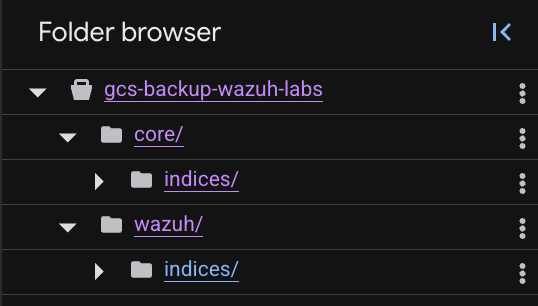
Also verify the repository on every cluster node with POST /_snapshot/<repository>/_verify, query GET /_snapshot/_status, and inspect the final snapshot for failed shards. Bucket objects alone are not acceptance evidence.
Restore Rehearsal
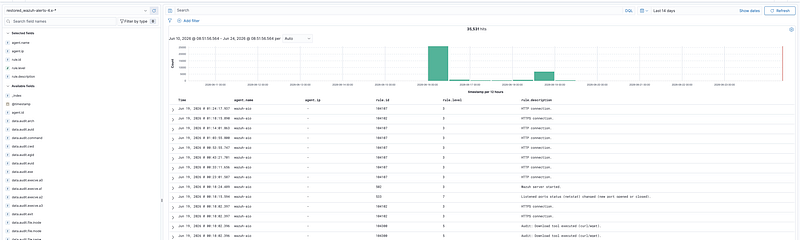
The screenshots below show a lab restore from the GCS bucket. A production rehearsal should restore into an isolated cluster or use renamed indices, exclude global state, and avoid overwriting live aliases. OpenSearch Security places restrictions on restoring global state and the .opendistro_security index; protect security configuration through its documented backup path rather than assuming a general data snapshot is a complete disaster-recovery backup.
- Currently last data is around Jun 22, 2026
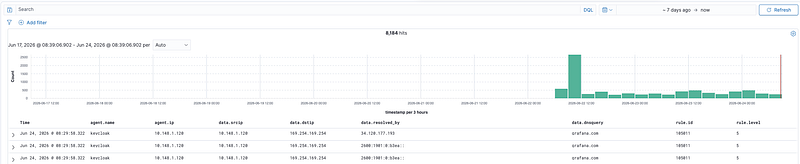
2. In this snapshot repository, backups start on Jun 17, 2026.
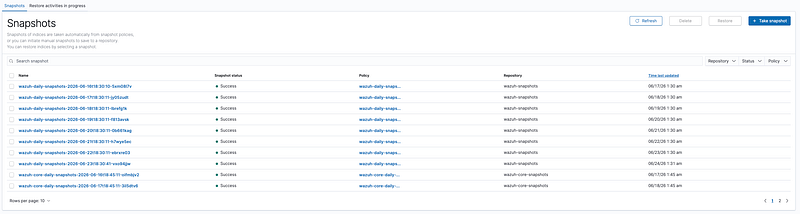
3. Now let’s try restoring the data for Jun 18, 2026.
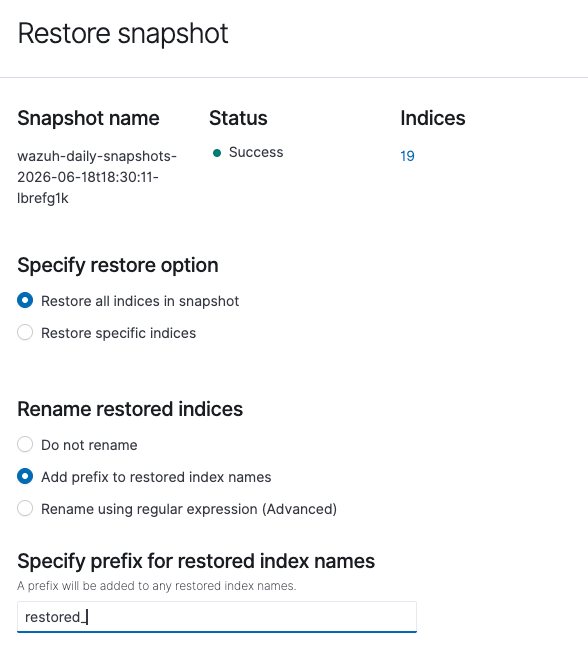

4. Once the restore is complete, query the renamed index and compare document count, time range, mappings, sample alerts, and application access against the recovery checklist. Creating a temporary index pattern is only a UI convenience, not integrity validation.
In the index search, it will be restored_wazuh-alerts-4.x-*, and you can now search for data from that date.
Final Notes
The repo does not try to make Wazuh a long-retention analytics platform. It keeps:
- Short live retention for predictable disk usage
- Short backup retention for operational recovery
- Everything described as inventory data, not hand-edited cluster state
The retention policy is also flexible. For example, live data in Wazuh can be configured for 1 year, while the latest backup data in GCS can be kept permanently. This only needs to be adjusted based on disk capacity, storage cost, recovery needs, and each company’s internal retention or compliance policy.
That keeps the indexer manageable and makes backup behavior reproducible.
Encryption, Monitoring, and Recovery Scope
Require TLS verification between the indexer and GCS, enable bucket encryption according to policy (customer-managed keys where required), restrict and audit key use, enable object versioning or retention controls only when their interaction with repository cleanup is tested, and prevent public access. Snapshot data can contain security events, usernames, IP addresses, paths, and other sensitive evidence.
Alert on repository verification failure, authentication/authorization errors, snapshot duration, failed shards, missing daily recovery points, cleanup failure, bucket capacity or cost anomalies, and restore-test age. Record RPO, RTO, indices included and excluded, plugin version, Wazuh/OpenSearch version, encryption key, credential owner, and the last successful restore rehearsal.
A snapshot protects selected index data; it does not automatically cover manager configuration, agent keys, certificates, Wazuh rules, Ansible secrets, or host recovery. Include those assets in the wider Wazuh backup and disaster-recovery plan.
Next: Part 11—Zeek Network Telemetry into Wazuh